
Entitlements
And how the poor have been systematically denied them

As I sat eating my breakfast today I read with dismay that leading tennis players are considering boycotting Wimbledon this year because they believe they are being underpaid. In the same article Aryna Sabelenka was reported to have earned NZ$5,425,000 for winning the French Open. The sharp reader will understand my dismay is over such a misplaced sense of entitlement that anyone earning these outrageous amounts for a single tournament could feel hard done by. In the comments section of STUFF, DavidC_848 explained…. "Tennis players receive no salary and cover all their own expenses. Their demands include pensions, health insurance, and maternity leave - things the Slams have never contributed to. “Fair enough I thought, maybe more money should go to those further down the tennis feeding chain, but no, Sabelenka and Jannik Sinner weren't arguing for this, they simply wanted a bigger slice of the cake for themselves.
I sat finishing my coffee considering what constitutes workplace entitlements, and at what stage, or under what conditions these may be challenged?
An erstwhile friend and teaching collegue on making his maiden speech in the 2023 parliament, as a list member for the ACT party, made much of his fathers involvement in the seafarers union and how he had subsequently rejected this union's position over strike action after the 'entitlement' to having beds 'made up' had been challenged by their employers. A small grievance, one might think, on the face of it. Except that this action was not an isolated act, rather one of a series to slowly erode and undermine working conditions that had been previously agreed upon as fair practice for seafarers members.
In Derbyshire in the early 1980's the local ministry of education unilaterally decided to combine two schools into one, resulting in teachers having to teach across two sites that were two miles apart. In some instances this meant changing sites during a morning break lasting no more that twenty minutes. As a unionist I fought along with others to insist that the local authority provided taxis to take teachers between sites, arguing that to expect teachers to use their own cars was an unjustified assumption which only served the authorities attempts at saving money. As a head of department in this new, dual site, campus my principal approach me with a request to help demolish a wall necessary in the construction of a larger teaching space. I immediately refused siting safety and employment issues. Later that day I discovered, behind my back, she had sought and reached agreement to complete this task from another member of my department. After a terse conversation I challenged her ethics and explained that no member of my department would be carrying out the work. She subsequently approached a builder.
I saw the writing on the wall for ethical education practice in the UK and soon after moved, first to Australia on teacher exchange, and then to New Zealand.
None of the work related issues I've identified are contentious or needing justification, yet many people would on first glance think they were reasonable requests.
But are they?
Why is it that entitlements won over years via union activism can be challenged by employers who wish to change the goal posts to suit themselves, whilst those of the ruling classes remain largely untouched?
As a teacher with 40 years service, I witnessed the erosion over time of concessions that had been won to ensure teachers were fairly compensated for the work we do, including that schools should provide a meal for teachers carrying out after-school activities such as parent teacher meetings, when the timetabling of such meetings failed to provide adequate time for staff to return home before being required to meet parents.
In most cases where 'entitlements' won by union activism have been dismantled it is the conditions of service, wages and collectivisation that have been targeted as a means to funnel more and more capital out of the pockets of workers and into the coffers of the ruling classes.
Bill Birch's 'Employment Contracts Act' of 1991 remains the single most devastating move crushing collective bargaining via national awards and introducing individual employment contracts. The net result has seen union membership decline, the erosion of conditions of service and the stagnation of wages as a proportion of an industry's financial cost.
This act, arguably, has seen an exponential transfer of wealth from the many; Unionism, manufacturing workers, Māori and Pasifika communities, beneficiaries, workers in protected industries, some small farmers, and regions dependent on state-sector employment, to the few; The Financial sector and dealmakers; Ron Brierley, Brierley investments, Chase Corporation. The buyers of privatised state assets; Telecom, Tranzrail and BNZ. Large export orientated agricultural businesses such as Fontera. The rise of property and capital owners; commercial properties, investment portfolios, businesses, and shares. Lastly foreign investors and multinational corporations.
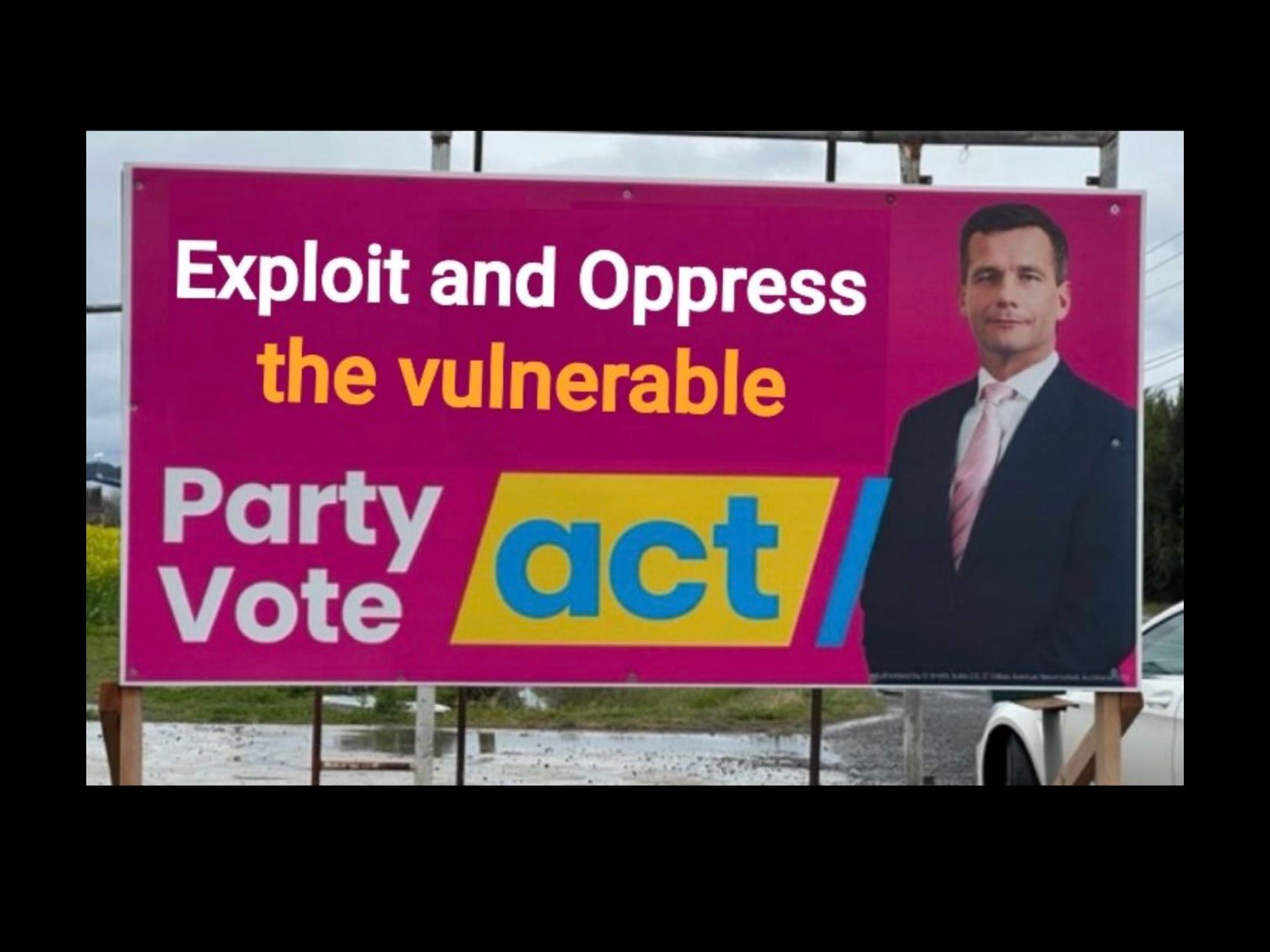
Some of the grossest examples of entitlement reside in a certain kind of mindset. One that posits an individual's view regarding Te Tiri o Waitangi and issues of equality trumps a whole history of academia and legal presidence. That simultaneously invalidates the work of the Waitangi Tribunal along with countless historical government initiatives to redress Māori injustices. It further believes that an 8% electoral college vote entitles a party to an outrageous influence and entitlement to reframe the very core of our Bi-Cultural identity.
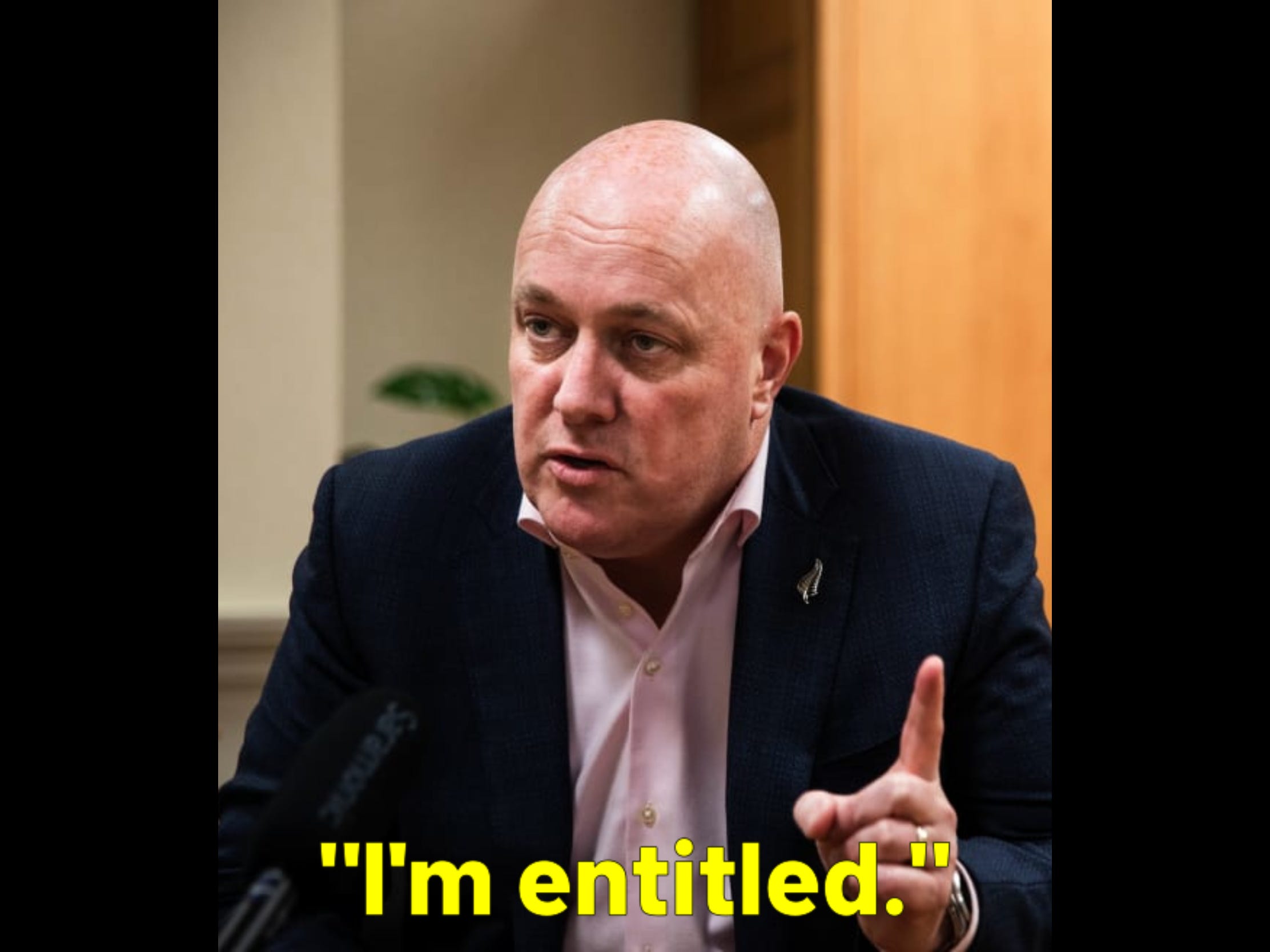
It is present in a newly elected Prime Minister who believes he is entitled to hire a chauffer driven limousine to drive him from one side of a street to the other on his inauguration day. To rent out his privately owned dwelling to his electoral party for use as his office, whilst also claiming a thousand dollars a week housing allowance to live in a property he owned outright. It is evident when challenged about these excesses, to claim "I'm entitled to it" or when he speaks of being "financially sorted" or when referring to the disadvantaged as "bottom feeders".
This pernicious 'entitlement' is evident in the mindset of a finance minister who believes. "Emtying the boot of a car" is an answer to solving runaway fuel costs or of referring to state-home renters as having "won Lotto", this whilst another minister is removing financial support for parents of challenges children to save costs. This same minister learning from her PM's play-book of claiming $52,000 per year to rent a house she also owns outright simultaneously increasing the state-house rentals for some of the most financially needy people of our country.
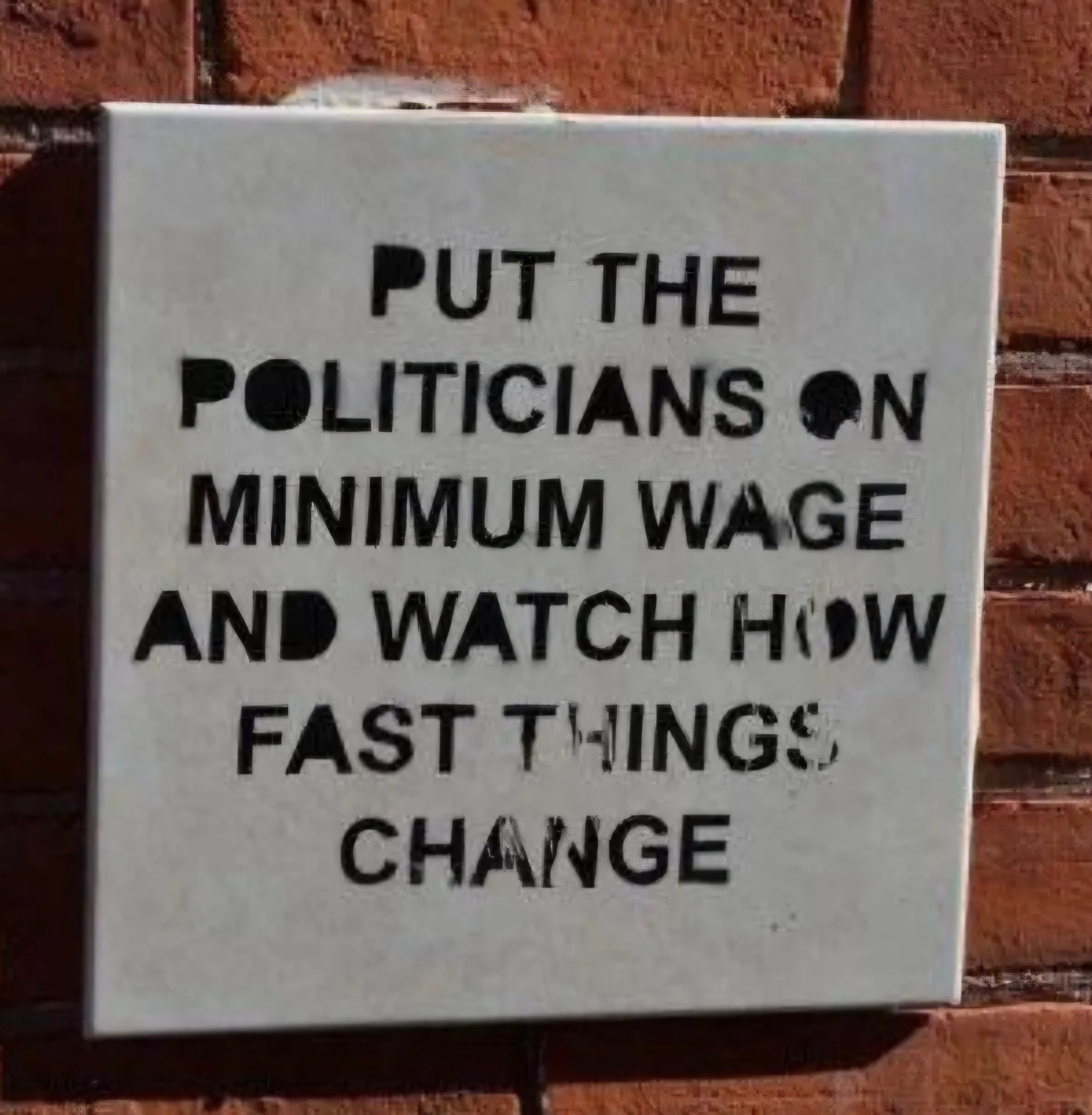
I kept a photograph in my classroom of a street graffiti from London days that claimed 'Put MP's on the minimum wage and see how fast things change'.
I believe it is well past time that we demand our MP's and the whole apparatus of society resets their view of entitlement away from the individual and to a collective version that shares the financial fortune of this country and the world in a more equitable and egalitarian manner.
I believe we get the governments we deserve. We certainly seem to end up with Prime Ministers who never speak for those on the fringes of society. In 70 odd years on this planet there have only ever been a handful of politicians who have consistently spoken truth to power; Anthony Wedgewood Benn, and Jeremy Corbyn in Britain and Chloe Swarbrick in New Zealand. Absolutely ALL the rest have been compromised by their failure to champion economic policies that would redistribute wealth from the few to the many
Thanks Mike I agree with you. I think the MPs will be justifying their entitlement when their salaries again rise this month. We are well past the days of this being a left/right struggle. It really is the working class/capital class struggle. And believe it or not. We have the numbers and therefore the power. Which unsurprisingly is why the capital class spends so much trying to get us to vote against our own best interests. With success unfortunately. Lastly. Bill Birch the Minister of Everything as he was sometimes known did pass The Employment Contracts act. NACT have demonstrated repeatedly how easy it is to change the law. Or repeal. Its a complete doddle.